- Generative AI
- Personalization
- eCommerce
- 14 min read
Is Rule-based Personalization Hurting Your eCommerce Store?
Published
16 June 2026

core insights box:
- Shoppers switch intent in seconds from browsing or comparing to buying in a fluid journey that static personalization can’t keep up with.
- Rule-based systems often fall behind, showing irrelevant products that break momentum and weaken purchase confidence at critical moments.
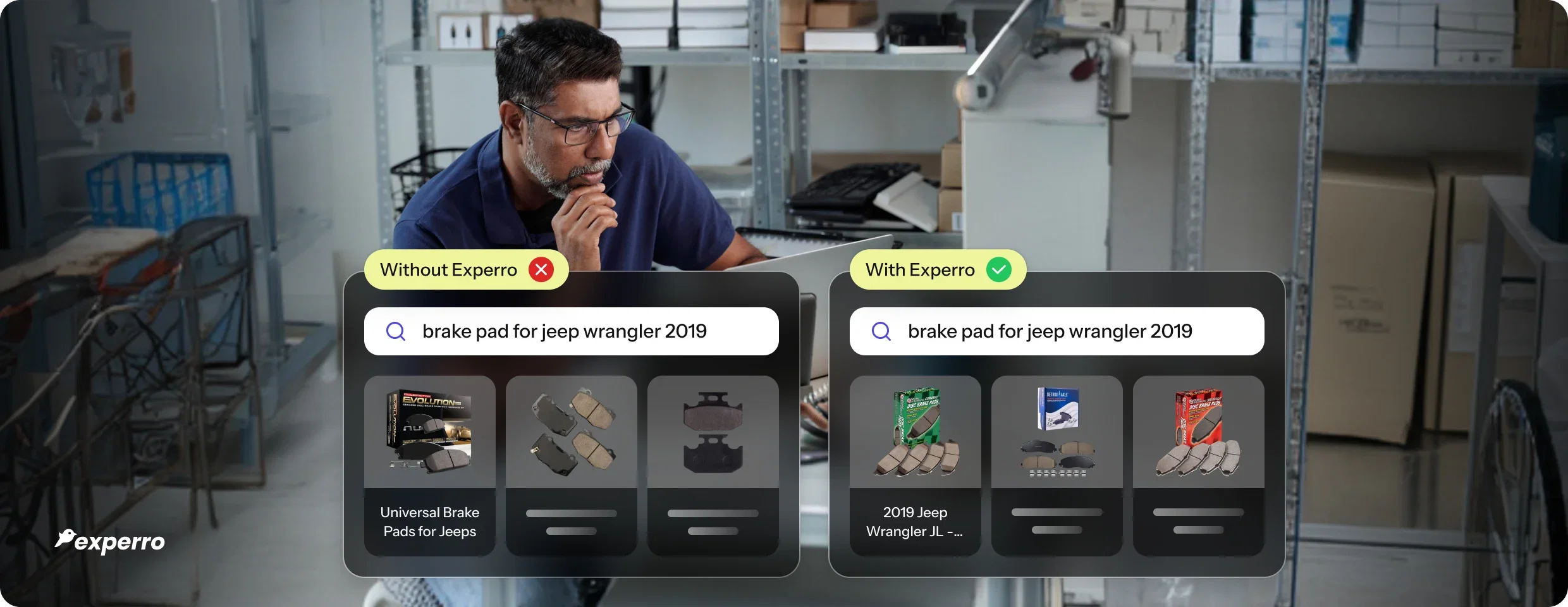
- Experro solves this with real-time AI personalization, unifying search, recommendations, and content to guide every shopper toward faster, more confident conversion.
The drop-off isn't happening at the ad. It's happening after.
Shoppers click, land, browse and leave... 😔 They leave because the experience felt generic. Like it wasn't built for them.
For years, eCommerce brands leaned on rule-based personalization to fix this. Set a trigger. Define a segment. Serve a recommendation. It felt like science. It felt like progress. BUT, it isn't working anymore... 👎
Today's shopper doesn't follow a script. They browse on mobile, abandon a cart, return from a desktop, and convert — all within the same hour. Rule-based systems, built on static segments and pre-written logic, weren't designed for this.
The result? Irrelevant experiences served at the worst possible moments. Missed conversions. Lost revenue. And a widening gap between what customers expect and what brands actually deliver.
Rule-based personalization isn't just underperforming — it's dying. And the brands still depending on it are paying a quiet, compounding price.
In this article, we break down exactly why rule-based personalization is failing modern eCommerce in 2026, and what the leading brands are replacing it with.
What Is Rule-based Personalization?
Rule-based personalization is the practice of using a set of pre-defined rules in digital commerce to tailor user experiences. This decides what content, products, or messages a visitor should see.
Some common rule-based personalization examples include:
- If a visitor belongs to a particular audience segment, display targeted banners (whether it matches his personal preferences or not)
- If a customer has visited a product page, trigger a related product recommendation pop-up (whether he engaged with it or not)
In simple terms, it works like a checklist:
“If condition A happens → show experience B".
This makes it easy to understand but also introduces rigidity. Everything depends on predefined rules, not evolving customer behavior, intent, or context.
How Does Rule-based Personalization Work in eCommerce?
Rule-based personalization in eCommerce works by using predefined rules based on customer data, user demographics, and behavioral data like browsing history and interactions, forming the foundational approach explained in getting started with personalization.
First, businesses collect signals such as clicks, page views, and customer behavior, then group users into fixed customer segments like new visitors or returning customers, a segmentation structure commonly used across approaches described in types of website personalization.
Next, marketers set manual rules or if-then logic (for example: if a user is a returning visitor, show the same product recommendations to all returning users), which defines how experiences are controlled and delivered across journeys.
Based on these rules, the system delivers dynamic content, pop-ups, banners, and product recommendations to create a personalized experience that remains consistent but predefined.
Finally, marketers continuously update rules manually based on performance, making optimization an ongoing effort rather than an automated process.
While this improves control, it still relies on static logic, limiting responsiveness compared to real-time systems like real-time personalization and highlighting the shift toward more adaptive models such as hyper-personalization in modern eCommerce personalization.
Why Rule-based Personalization Is No Longer Effective in 2026
There was a time when rule based personalization systems felt like the perfect solution for eCommerce. Marketers could define predefined rules, group users into customer segments, and confidently deliver “personalized” experiences using simple logic.
It worked, until customer behavior stopped being predictable.
In 2026, eCommerce isn’t static anymore. It’s fast. And that’s exactly where traditional rule based personalization starts to break.
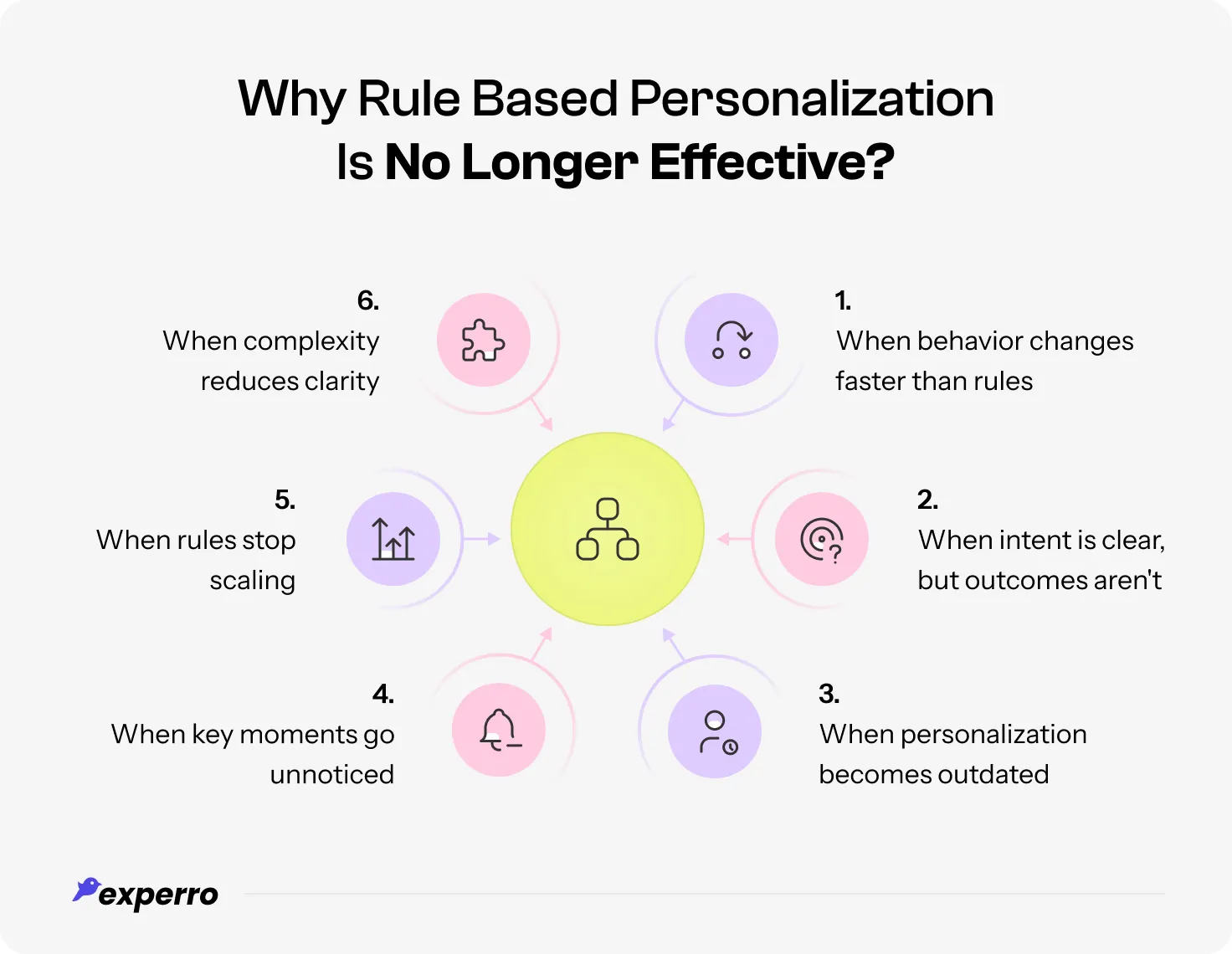
1. When behavior changes faster than your rules
A shopper lands on your website with an intend to buy something. And then the intent changes within seconds.
But rule-based personalization systems are still waiting for predefined conditions like:
- segment match
- location trigger
- past browsing rule
So by the time, the system reacts, the moment has already passed.
That gap between customer behavior and system response is where relevance gets lost, and conversions quietly drop.
2. When intent is present, but the system still guesses wrong
This is one of the biggest rule-based personalization limitations.
A customer may be classified under a customer segment like “returning users”, but their intent could be completely different; maybe they’re buying a gift for somebody else, exploring a new category, or comparing alternatives.
Yet the system continues relying on rules based targeting built on historical customer data, not current intent.
The result? A disconnect between what the customer needs right now and what they actually see.
3. When personalization feels outdated instead of helpful
In theory, dynamic content and product recommendations should feel relevant. But with rule-based personalization, they often feel stuck in the past.
Shoppers still see:
- Irrelevant pop-ups
- Repeated banners
- Old category suggestions
- Generic “you may also like” blocks
This misalignment is a common failure point even in systems trying to improve relevance, as highlighted in personalized search.
In fact, 58% of consumers say they receive product recommendations they don't want. Even when browsing behavior signals a new intent, static rules struggle to adapt.
The result is an experience that feels disconnected, and 71% of shoppers are willing to leave when relevance disappears at the moment.
4. When micro-moments are missed entirely
Modern eCommerce decisions happen in micro-moments:
- a scroll
- a pause
- a product click
- a search refinement
These micro-signals are central to how intent is interpreted in systems like search intelligence.
But rule-based strategies don’t respond in real time. They wait for conditions to be met.
So during critical decision windows, the system fails to surface the right content, missing opportunities for engagement, repeat purchases, and conversions.
5. When manual rules become a scaling problem
At first, rule based personalization feels easy to manage. But as the store grows, so does complexity.
Marketers end up managing:
- hundreds of manual rules
- overlapping logic layers
- constant rule maintenance
- inconsistent experiences across pages
This challenge becomes even more visible in evolving architectures discussed in composable commerce, where flexibility is key, but static rule systems struggle to keep pace. What started as control quickly turns into operational overload.
6. When more rules create less clarity
Ironically, adding more rules doesn’t improve personalization; it often makes it worse.
As complexity increases, systems struggle with:
- conflicting logic
- outdated conditions
- rigid segmentation
- limited adaptability
Instead of improving relevance, personalization becomes fragmented across the experience layer.
Rule-based personalization is falling behind in this era where customers change intent instantly, expectations are higher than ever, and static rules simply can’t deliver relevance anymore.
Hence, rule-based personalization is no longer effective in the current time.
AI Personalization vs Rule-based: What Actually Changes?
Before moving ahead, pause here, because this is where things change. You’ll learn why traditional rule-based personalization struggles and how AI-driven systems redefine relevance through continuous learning from shopper behavior.
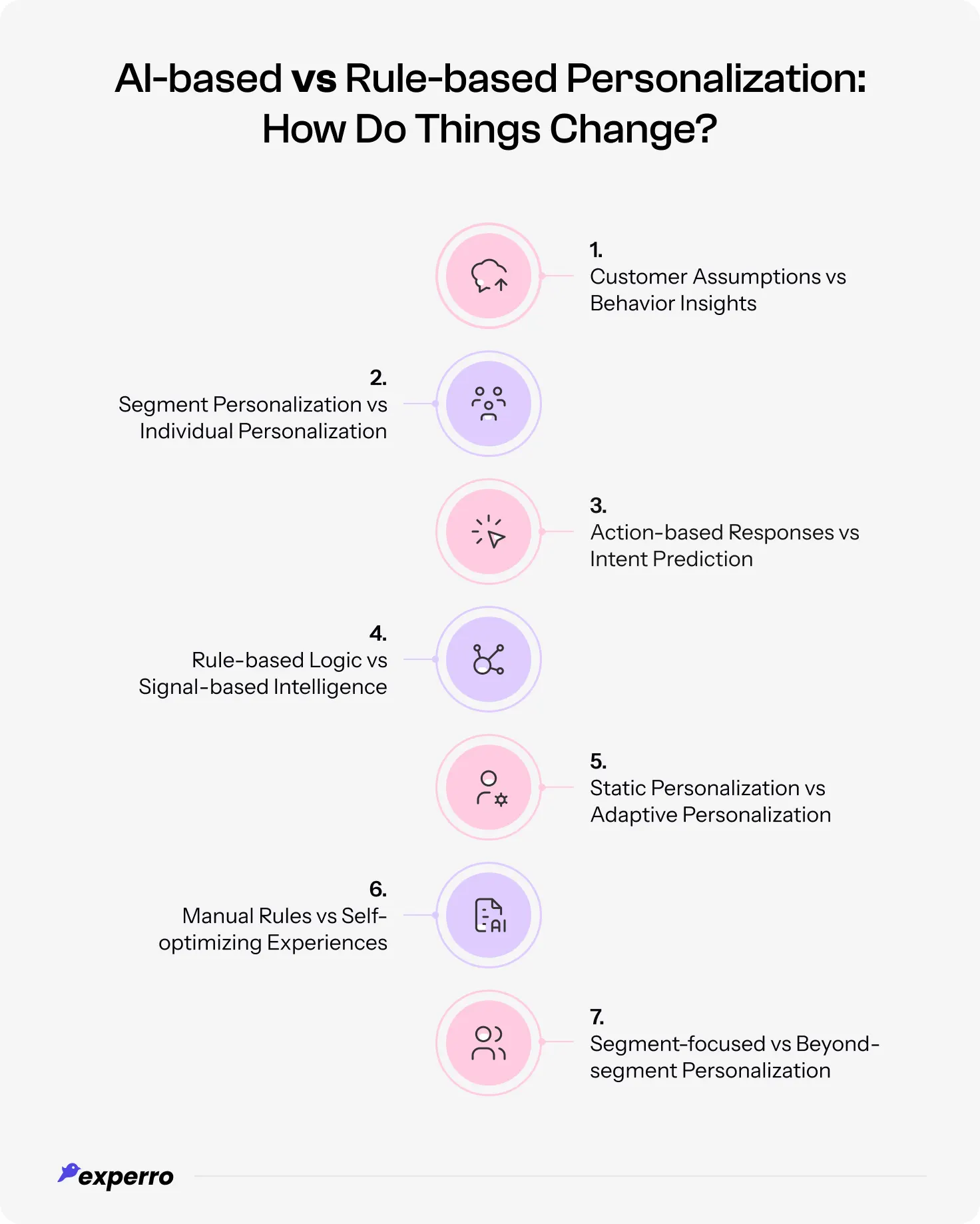
1. Assumptions About Customers vs Understanding Actual Behavior
Traditional rule-based personalization systems rely on assumptions created by teams.
AI personalization learns directly from what shoppers are doing, making decisions based on behavior rather than predefined expectations.
2. Personalizing for Segments vs Personalizing for Individuals
Most rule based segmentation strategies group shoppers into broad audiences.
AI moves beyond static segments in eCommerce by adapting experiences to individual browsing patterns, interests, and intent signals.
3. Responding to Actions vs Anticipating Intent
Traditional trigger-based personalization reacts only after a defined action occurs.
AI shifts this model by predicting intent before the next click, a capability aligned with advancements in predictive customer analytics.
This allows stores to surface relevant products, content, or recommendations proactively rather than reactively.
4. Following If-Then Rules vs Interpreting Multiple Signals
Traditional rules-based targeting depends on programmed if-then rules.
AI evaluates multiple behavioral, contextual, and transactional signals simultaneously to determine what experience is most relevant in the moment.
5. Static Personalization vs Continuously Evolving Personalization
With static personalization, experiences remain limited to predefined rules until someone updates them.
AI continuously adapts to changing shopper behavior, product trends, and engagement patterns without requiring constant manual intervention.
6. Manual Rule Maintenance vs Self-optimizing Experiences
As personalization scales, manual rule maintenance becomes increasingly complex and error-prone.
AI reduces this burden by continuously optimizing recommendations, search relevance, and merchandising decisions based on performance feedback loops, similar to the direction explored in search as a service.
The system improves itself over time without constant manual intervention.
7. Personalization Within Segments vs Personalization Beyond Segments
One of the biggest rule-based personalization limitations is its dependence on audience definitions. AI enables personalization beyond segments, using context and shopper behavior to deliver more relevant experiences for every visitor.
The biggest shift isn't simply replacing rules with automation. It's the ability to respond to customer behavior as it happens.
Effective personalization allows brands to adjust recommendations, content, search results, and merchandising experiences instantly based on changing shopper intent.
This ensures customers always see the most relevant products and content, reducing friction, and creating a smoother path to purchase.
Thus, the above are the things that change when it is rule-based or AI-based personalization.
Why Rule-based Personalization Fails Modern eCommerce Experiences Today?
At first glance, rule-based personalization seems like a logical approach. Create audience segments, define a set of if-then rules, and deliver experiences based on those conditions.
But modern eCommerce is no longer THAAAAT predictable. ❌
Today's shoppers jump between categories, compare products, refine their preferences, and change their intent multiple times throughout a single session. The problem is that most rule based personalization systems are designed to follow predefined instructions, not adapt to changing behavior.
As a result, personalization often struggles to keep pace with how customers actually shop.
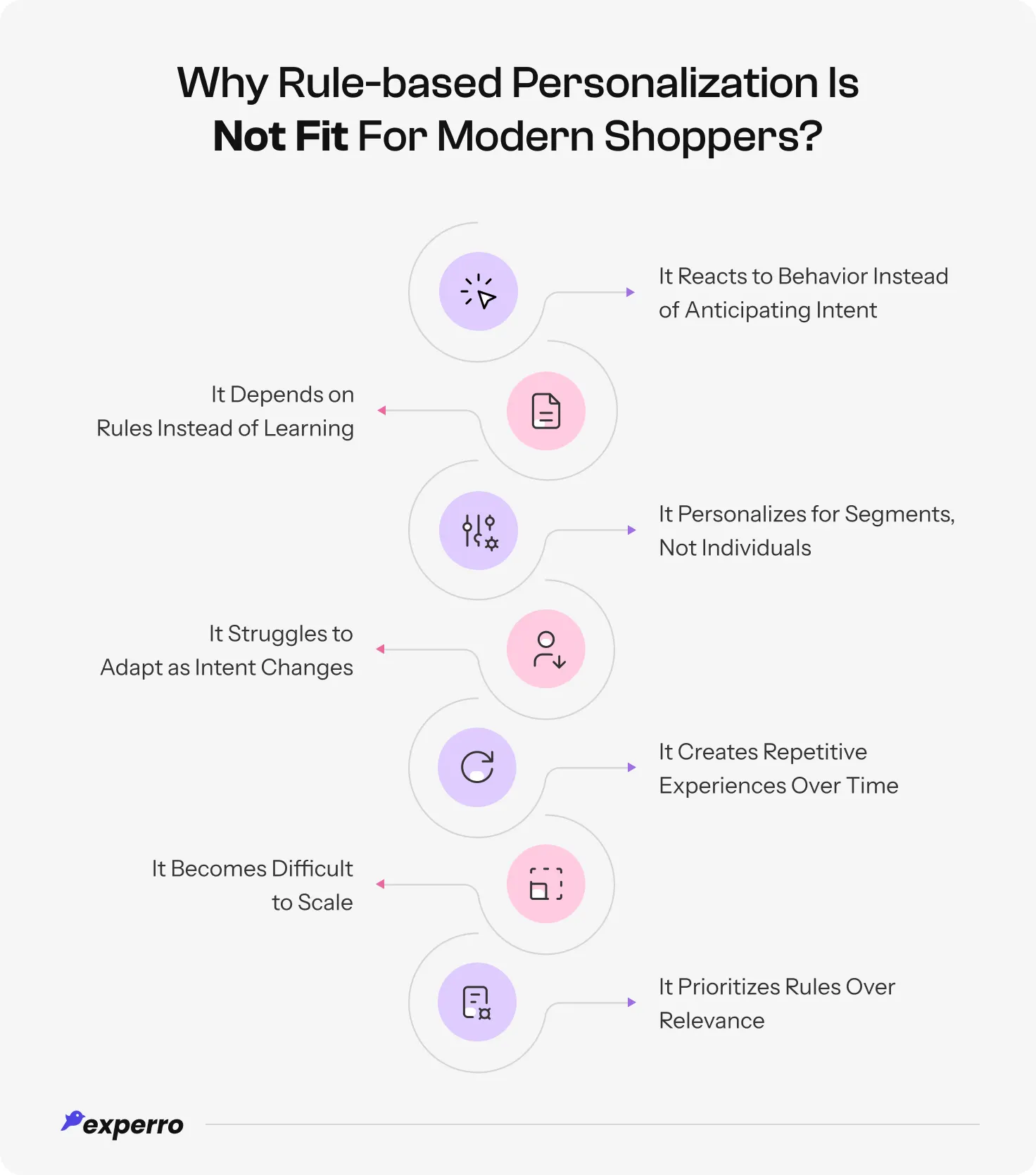
1. It Reacts to Behavior Instead of Anticipating Intent
Most trigger-based personalization waits for a shopper to take a specific action before responding. While this can work for simple use cases, it often means personalization is one step behind the customer.
By the time a rule activates, the shopper's interests may have already evolved.
2. It Depends on Rules Instead of Learning
Traditional rules based personalization executes exactly as configured. If customer behavior changes, the experience remains the same until someone updates the rules.
This creates a gap between what shoppers are looking for and what the personalization engine continues to show.
3. It Personalizes for Segments, Not Individuals
Many rule based segmentation strategies group shoppers into broad audiences based on shared characteristics or past actions.
The challenge is that shoppers within the same segment rarely behave the same way. What feels relevant to one customer may be completely irrelevant to another, making personalization less precise than intended.
4. It Struggles to Adapt as Intent Changes
Customer journeys are rarely linear. A shopper may start by casually browsing, move into product research, and become ready to purchase within minutes.
Because static personalization relies on predefined conditions, it often struggles to recognize and respond to these shifts in real time.
5. It Creates Repetitive Experiences Over Time
When personalization is driven by fixed rules, the same recommendations, products, and messages tend to appear repeatedly.
Instead of helping shoppers discover something new or relevant, the experience can start feeling predictable and disconnected from their current interests.
6. It Becomes Difficult to Scale
As catalogs expand, customer segments grow, and campaigns become more sophisticated, the number of rules increases rapidly.
What begins as a manageable personalization strategy can eventually turn into ongoing manual rule maintenance, making it harder for teams to keep experiences accurate and relevant.
7. It Prioritizes Rules Over Relevance
At its core, a rule-based personalization engine is built to follow instructions. If a condition is met, the rule executes.
Modern shoppers expect experiences that reflect their interests, not experiences driven by outdated rules and assumptions.
The biggest challenge with rule-based personalization isn't that it stops working entirely, it's that customer expectations have evolved. If you've ever wondered what happens when personalization goes wrong, the answer is often irrelevant recommendations, repetitive experiences, and content that no longer matches shopper intent.
As customer journeys become more dynamic, brands need personalization that adapts to changing intent and stays relevant throughout every interaction.
How AI-Powered Personalization Solves the Limitations of Rule-based Systems?
Modern shoppers don't follow predefined paths. They explore, compare, search, leave, return, and change their minds throughout the buying journey. That's why many rule-based personalization strategies struggle to keep experiences relevant.
Instead of relying on static rules and manual decisions, AI-powered personalization continuously learns from shopper behavior and adapts experiences in real time.
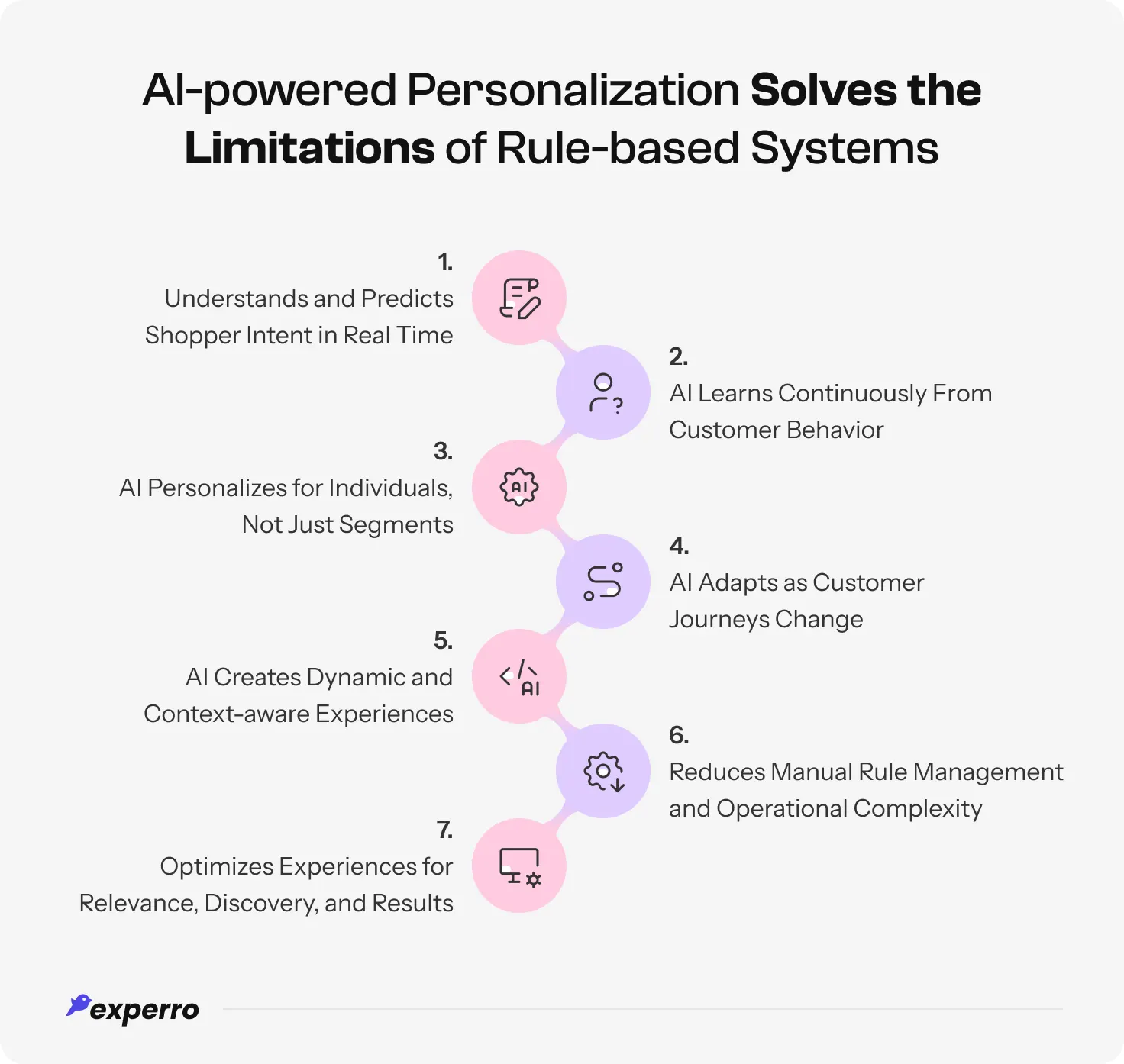
Here's how it addresses the biggest limitations of traditional rule-based systems:
1. AI Understands and Predicts Shopper Intent in Real Time
Unlike traditional rule-based personalization in eCommerce, which often responds only after a shopper takes a specific action, AI takes a more proactive approach.
Experro analyzes behavioral signals such as searches, clicks, product views, category exploration, and engagement patterns as they happen.
This helps identify intent while the journey is still unfolding, enabling more relevant experiences and supporting capabilities like predictive search for eCommerce that anticipate shopper needs before they fully express them.
Instead of reacting to past actions alone, AI can predict what shoppers are likely to need next and deliver the right products, content, and recommendations at the right moment.
2. AI Learns Continuously From Customer Behavior
Traditional rules based personalization follows instructions. If shopper behavior changes, someone must update the rules.
Experro's AI continuously learns from customer interactions. As shopper preferences, product trends, and buying patterns evolve, personalization evolves with them.
The result is a system that improves over time rather than remaining dependent on manual updates.
3. AI Personalizes for Individuals, Not Just Segments
Many rule based segmentation strategies group shoppers into broad audiences. While useful for basic targeting, segments rarely capture individual intent.
Experro moves beyond static segments in eCommerce by evaluating each shopper's behavior in real time.
Two shoppers may belong to the same audience group, but their experiences can be completely different based on what they are actively searching for, viewing, and engaging with.
4. AI Adapts as Customer Journeys Change
Customer intent is not static.
A visitor researching products today may become a high-intent buyer tomorrow. Someone comparing options on one page may be ready to purchase on the next.
Unlike static personalization, Experro continuously adjusts recommendations, content, merchandising, and discovery experiences as customer behavior changes.
This keeps personalization aligned with the shopper's current intent, not their past actions alone.
5. AI Creates Dynamic and Context-Aware Experiences
One of the biggest rule-based personalization limitations is that experiences often become repetitive.
Experro uses AI to evaluate context, behavioral patterns, product relationships, and customer interests before deciding what to show next.
This creates dynamic personalization that feels relevant to the shopper's current needs rather than repetitive rule execution.
As customer expectations continue to rise, this level of adaptability is becoming the foundation of hyper-personalization, where every interaction is shaped by individual behavior, preferences, and intent in real time.
6. AI Reduces Manual Rule Management and Operational Complexity
As eCommerce businesses grow, managing hundreds of programmed rules becomes increasingly difficult.
Experro reduces dependence on manual rule creation and maintenance by allowing AI to make personalization decisions automatically.
Teams spend less time managing rules and more time focusing on strategy, customer experience, and business growth.
7. AI Optimizes for Relevance, Discovery, and Business Outcomes
Traditional rule-based personalization engines are designed to execute conditions.
Experro is designed to optimize outcomes.
Its AI continuously evaluates what drives engagement, product discovery, conversions, and customer retention. Instead of asking whether a rule should fire, the platform focuses on delivering the most relevant experience for each shopper.
The Experro advantage lies in moving beyond static, rule-based personalization toward intelligence that adapts to evolving shopper intent.
By continuously learning from behavior and context, AI-powered personalization delivers more relevant experiences and higher engagement, while also paving the way for agentic personalization that proactively guides shoppers toward the most meaningful products and outcomes.
Where Do You Go From Here?
If you've made it this far, chances are some of these challenges sound familiar. Your team may be spending time managing rules, updating segments, and fine-tuning campaigns, yet shoppers still struggle to find the products that matter most to them.
The challenge is not a lack of effort. It is that customer behavior changes faster than static rules can keep up.
Today's shoppers expect experiences that adapt to their interests, intent, and actions in real time. They want relevant products, helpful recommendations, and smoother paths to purchase. Meeting those expectations requires more than predefined logic.
The brands gaining an advantage today are using AI to understand customer behavior as it happens and deliver more relevant experiences at every step.
If you're ready to move beyond rule-based personalization, contact us to explore how Experro can help you improve product discovery, engagement, conversions, and customer retention with AI-powered personalization.
FAQs

With 6+ years of experience in AI, software, and digital transformation across tech, healthcare, and fashion, Rahul focuses on making complex ideas simple, clear, and actually useful. He has learned how often great ideas get lost in complexity, which is why he centers his writing on clarity, helping entrepreneurs and leaders cut through noise and make decisions with confidence.
Subscribe to Our Newsletter!
Get the latest insights delivered straight to your inbox.